

What to Bring to Supervision: A Practical Workbook
Supervision is one of the most valuable spaces we have to reflect, grow, and reorient ourselves in the work we do with others. But too often, we arrive in Supervision sessions rushed, scattered, or unsure of what we truly want to bring.
Taking time to self-prepare before Supervision isn’t just a practical step - it’s a powerful form of self-care and professional development. It helps us show up more honestly, use the time more effectively, and deepen the impact of the Supervision process itself.
Self-preparation allows us to:
Identify what really needs our attention
Notice patterns over time
Surface thoughts or feelings that may otherwise go unspoken
Clarify learning goals and supervisee needs
Develop our own ‘internal supervisor’ - that reflective inner voice that grows with us
We’ve put together a workbook on how to prepare and get the best from Supervision.
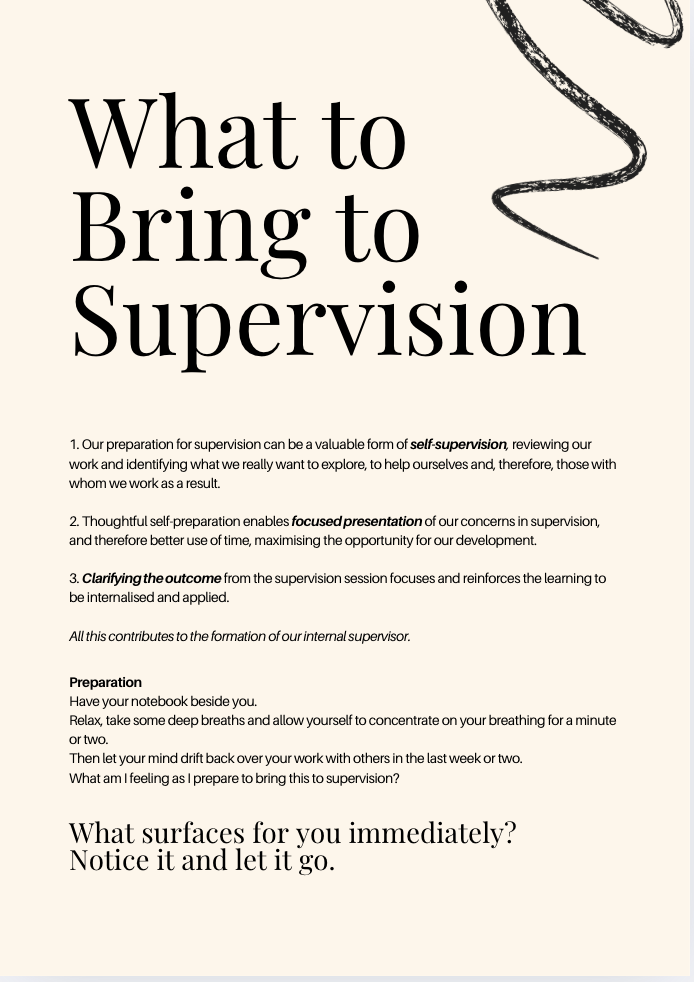
Preparation
Have your notebook beside you. Relax, take some deep breaths and allow yourself to concentrate on your breathing for a minute or two. Then let your mind drift back over your work with others in the last week or two.
What surfaces for you immediately? Notice it and let it go.
Reflect
Read the following prompts, you do not have to answer all of them fully or at all. Pause as you read each question, you might ask yourself:
“What am I feeling as I read this?”
“Did I skip past one quickly?” (Sometimes avoidance reveals where the richest material lies).
“Did something bring a person or moment to mind?” (Even a faint pull of curiosity is worth pausing with.)
What things left you feeling pleased? In what way did they go well?
What interventions (i.e. things that you said or did) seemed to be most helpful?
Which interactions have you enjoyed most? What were your feelings at the time?
What was difficult for you? How did you feel when experiencing these difficulties?
What were you, are you, uncertain about?
What are you looking forward to—or dreading?
Is there anything I’m hesitant or embarrassed to share?
Are there some doubts/anxieties just ‘out of view’ that you would rather remain out of view? Identify the feelings not the items.
Gather
Now jot down a list of what has surfaced for you as a result of this reflection.
Glean
Intentionally shape how you show up in supervision not just with what you bring, but how you bring it.
What do I want to learn right now?
Think beyond just solving a problem. Ask yourself:
What would I like to understand better about myself, my responses, or a situation?
What personal or professional skill feels like it's quietly calling for development?
Is there a pattern I’m starting to notice that I’d like to unpack?
Examples:
“I want to learn how to stay grounded when a directee bring this topic.”
“I’m noticing I feel drained after certain sessions—why is that happening?”
“I want to explore how to balance empathy with boundaries.
Air
Even if what you reflect on doesn’t make it into the session, the act of surfacing it lifts it out of your inner world.
This alone can:
Release tension
Bring clarity
Help you feel less alone with something
“If I could air one thing, just to name it and breathe around it, what would it be?”
Ultimately, preparing for supervision is a valuable form of self-supervision in its own right. Taking the time to review your work and identify what you truly need to explore doesn't just maximise your time in the session, it directly benefits the people you support. By arriving with a focused plan and leaving with clear, actionable outcomes, you deeply internalise your learning. Over time, this deliberate practice does something powerful: it shapes and strengthens your own internal supervisor.